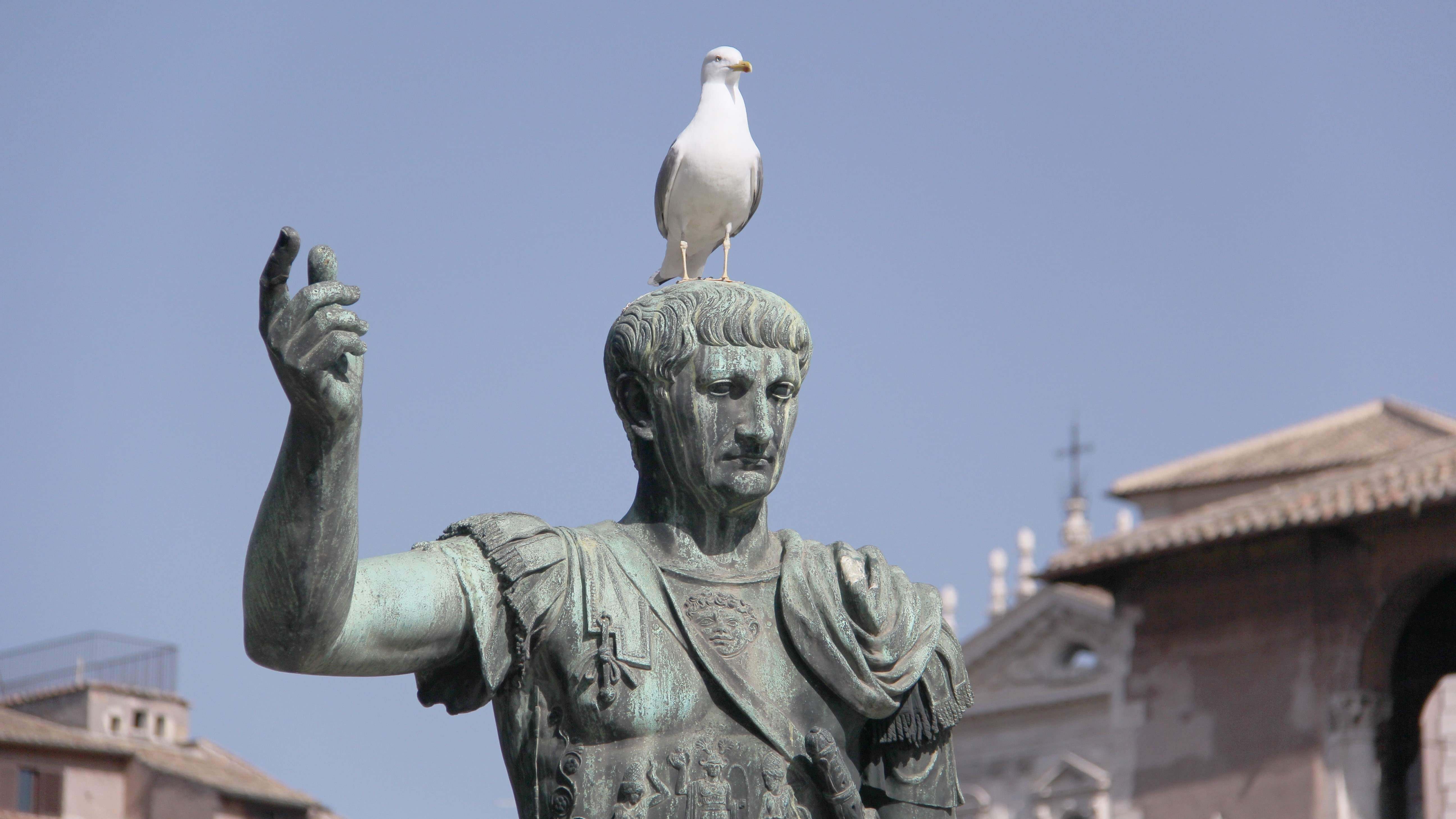
Julius Caesar’s career, spanning over two millennia, stands as a timeless model of exceptionally successful leadership. The total of his achievements and the legacy he left behind as a consequence are a testament to his multifaceted leadership skills, making his career a compelling study for modern leaders.
However, Caesar's journey was not without flaws, and the most intriguing lessons emerge from the distinction between excellence and perfection.
Here are five enduring leadership lessons from Caesar’s career.
Career building happens through branding
The Roman Republic knew a clearly structured career path, a uniquely modern approach to organisational development compared to other historical state systems. It was key to the success and longevity of Rome’s empire. Caesar followed this path successfully from the bottom to the top. He started to build his leadership brand early on.
Caesar founded his brand on incorruptibility and clemency towards adversaries as well as consistently delivering on promises, such as land distribution for the people and career opportunities for his staff. Meeting stakeholders’ expectations (and ensuring that his achievements were well known) led to Caesar’s next promotion.
Shared leadership only works with genuine balance
Caesar is known for having built the archetype of a political coalition: the so-called First Triumvirate, along with Pompey and Crassus. Caesar took the initiative to bring three ambitious leaders together to realise their respective interests, which each one, on their own, was unable to achieve.
Each contributed with their unique strengths: Pompey’s support of his victorious army, Crassus’ wealth, Caesar’s political organisation. A balance of power, preventing any one ambitious member from overshadowing the others, held the triumvirate together.
It worked well for seven years until Crassus fell in battle. Soon, the remaining two increasingly drifted apart until Caesar crossed the Rubicon into a final showdown.
Followers wield more influence than you might realize
This famous crossing of the Rubicon, which marked the beginning of a civil war that ultimately led to Julius Caesar’s assumption of supreme power, is often portrayed as a calculated move by Julius Caesar himself.
Upon closer examination, it reveals another lesson. Caesar’s adversaries worked hard on Pompey, the other remaining member of the triumvirate, to draw him to their side. Caesar, away in Gaul to complete his conquest, led others to deal with matters on his behalf in Rome.
The issue was what would happen to Caesar next: a new responsibility in Rome (Caesar’s wish) or a career break. Caesar’s spokesmen in Rome urged more aggressive stances, for they believed that their fortunes depended on Caesar staying in power. And so did his military officers and inner circle, who provided counsel that aligned with their own interests.
Such hidden agendas effectively filtered what Caesar heard and shaped his perceptions of the viable path forward. Many leaders struggle with delegating and often take on too much themselves. However, there’s a limit to delegation. A heart-to-heart in person between Caesar and Pompey, who had collaborated effectively before, could have led to the de-escalation needed to prevent a civil war.
Excellence becomes perilous in the absence of feedback
Caesar’s mastery of action, organisation and innovation propelled him through Rome’s hierarchy and brought him victory on the battlefield. Yet once he reached the top, he applied the same forceful habits without adapting to a new context that demanded restraint and persuasion. Once he had peace restored, he utilised his dictatorial powers to implement a vast number of changes swiftly.
Many of his stakeholders welcomed this much-needed programme of reform and investment. Others, notably those in the upper class, were more lukewarm in their reception, uncertain about what it would mean for them. Rather than exploring what was behind the lack of buy-in, Caesar doubled down on his strengths and steamrolled an influential fringe of his stakeholders and followers.
Caesar’s case holds a warning. Whereas strengths are the motor for career progression, at a senior level, strengths risk turning into a vulnerability. Rather than relying on the same strengths, it may be better to tone them down in favour of generalist and people skills. What Caesar missed was adequate feedback to become aware of the imbalance in his behaviour. He did not actively seek feedback, nor did he give the impression to his followers that he needed it.
Without emotional intelligence, you may get stabbed in the back
Several times during his career, Julius Caesar was caught off guard by uprisings that threatened his success and life. When he thought he had conquered and pacified Gaul, all Gaul suddenly rose in revolt, posing the most significant threat of the entire campaign to Caesar and his army.
The same happened some years later when Caesar was busy in Rome, dealing with the aftermath of the civil war and decommissioning his army, believing it was over. In Spain, a sudden and powerful insurrection of locals and Romans alike threatened the recent peace.
In both cases, only Caesar’s military prowess was able to turn the tables in his favour, but not without great effort from his army and danger to his life. Caesar had been oblivious to the emotional undercurrents that sparked these rebellions against the might of Caesar's military.
At the end of his career, Caesar’s emotional intelligence again failed him. He did not sense the dissatisfaction and frustration among an essential part of his stakeholders, whose personal grievances overshadowed Caesar’s successes in battle and in government. On the Ides of March 44 BC, Caesar was unable to reverse fate one more time.
The enduring takeaway
It is often thought that Caesar’s tragic end at the hands of his followers was due to overreach or hubris. Instead, it was the result of insufficient feedback on his most crucial weakness, emotional intelligence. Therein lies the most important lesson.
Paul Vanderbroeck, PhD, is a Swiss-Dutch historian, leadership scholar, executive coach, and author of new book “Lead Like Julius Caesar”, with over 20 years of experience working with senior leaders and high-potential professionals across diverse sectors.
He is also the author of two more business books: Leadership Strategies for Women (Springer, 2014) and The International Career Couple Handbook (Springtime Books, 2021).





 Share article via email
Five Leadership Lessons from the Career of Julius Caesar
Thanks for signing up to Minutehack alerts.
Brilliant editorials heading your way soon.
Okay, Thanks!