
Business group welcomes Prime Minister’s focus on investment and infrastructure but says private capital must remain central to his economic programme.
Business
CBI Backs Burnham Growth Plans But Warns State Must Not Crowd Out Business
Business group welcomes Prime Minister’s focus on investment and infrastructure but says private capital must remain central to his economic programme.
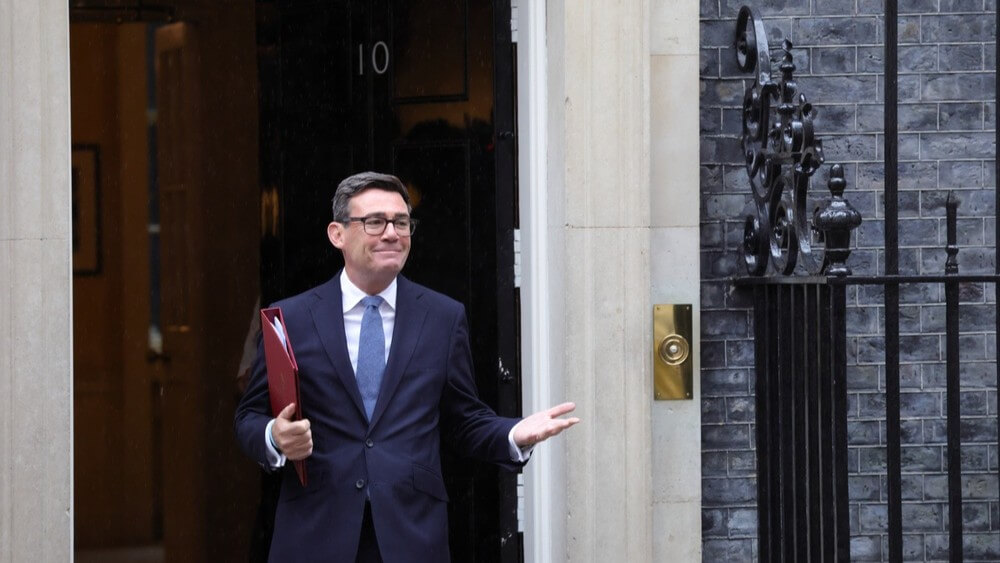
The CBI has cautiously welcomed Prime Minister Andy Burnham’s plans for a more interventionist state, but warned that increased public investment must be used to attract rather than displace private capital.
Rain Newton-Smith, chief executive of the business group, said Burnham’s first Labour conference speech as prime minister set out an ambitious vision for transforming the economy that would ultimately depend on businesses providing investment, expertise and innovation.
“Public investment should be designed to crowd in, rather than crowd out, private capital,” she said.
Burnham used his speech in Liverpool to outline plans for greater state involvement in energy and other infrastructure while promising to tackle long-running challenges including social care and youth unemployment.
Among the most significant announcements was Great British Grid, a publicly owned company within Great British Energy that will invest in electricity network infrastructure and compete alongside private operators.
The government says the body will help businesses secure faster grid connections and encourage investment, while Burnham has set a goal of bringing UK energy costs into line with other European countries within 10 years.
Newton-Smith welcomed the proposal but said its success should be judged by whether it accelerated connections without displacing private investment.
Britain faces a significant expansion of its electricity infrastructure as renewable generation increases. Ofgem has estimated that about £70bn of investment will be required in the grid between 2025 and 2031, while much of the spending is expected to come from private companies.
The CBI also welcomed Burnham’s willingness to examine difficult choices over the state pension and social care. Ministers have left open the possibility of reviewing the pensions triple lock as the government develops plans for a new social care system, although no decision to abolish it has been announced.
Newton-Smith said similar ambition was needed to tackle youth unemployment, alongside policies that gave businesses confidence to recruit and invest.
The CBI chief also backed Burnham’s commitment to fiscal discipline and a closer economic relationship with the EU, while welcoming what she described as a pragmatic approach towards the North Sea.
“The Budget now needs to provide the first downpayment on that partnership,” Newton-Smith said.
She called on Chancellor John Healey to relieve some of the cost pressures facing employers in his October 28 Budget, arguing that businesses needed greater confidence to invest and hire.
The intervention reflects the cautious improvement in relations between the government and corporate Britain at Labour’s conference, although business leaders remain focused on whether next month’s Budget will result in further increases in their tax burden.



Most read in News
Trending articles on News
Top articles on Minutehack


 Share article via email
CBI Backs Burnham Growth Plans But Warns State Must Not Crowd Out Business
Thanks for signing up to Minutehack alerts.
Brilliant editorials heading your way soon.
Okay, Thanks!