
Technology
Driving Growth: Effective Marketing Strategies For Local and Service-Based Businesses

Building Your Digital Foundation: Mastering Local SEO
Before diving into the intricacies of paid advertising, it’s essential to establish a robust digital foundation through Local SEO. For pest control businesses, this means optimizing our online presence to attract customers within our specific service areas. When people face a pest problem, their immediate instinct is often to search online for local solutions. In fact, 97% of people search online for local services, making our visibility in these searches paramount.

Local SEO helps us rank higher in local search results, including Google's Local Pack, which displays a map and a list of three businesses. This prime real estate is often the first place potential customers look. A strong Local SEO strategy ensures that when someone in our service area searches for "ant exterminator near me" or "termite control [city name]," our business appears prominently.
Optimizing Your Google Business Profile
Our Google Business Profile (GBP) is arguably the most critical component of Local SEO. It's our digital storefront on Google Search and Maps. To maximize its effectiveness, we must ensure:
- Business Information Consistency: Our business name, address, phone number (NAP), and website URL must be identical across all online listings. Inconsistencies can confuse both potential customers and search engines.
- Service Areas: Clearly define our service areas, whether by specific cities, zip codes, or a radius around our main location. This helps Google accurately match our business with local searches.
- Photos and Videos: High-quality images of our team, vehicles, and work in action build trust and showcase professionalism. Videos can further engage potential customers, offering a glimpse into our services.
- Q&A Section: Actively monitor and answer questions in the Q&A section. This demonstrates responsiveness and provides valuable information to prospective clients.
- Google Posts: Regularly publish Google Posts to announce special offers, new services, or company updates. These posts appear directly in our GBP listing, keeping it fresh and engaging.
The Power of Online Reviews and Reputation Management
In the pest control industry, trust is everything. Customers invite us into their homes and businesses, so they need to feel confident in our reliability and expertise. Online reviews are the modern-day word-of-mouth, and they play a massive role in building this trust.
- Customer Testimonials: Encourage satisfied customers to leave reviews on our Google Business Profile, Yelp, Facebook, and other relevant platforms. Positive testimonials act as powerful social proof.
- Review Generation Strategies: Implement strategies to consistently generate new reviews, such as sending follow-up emails after service, using QR codes on invoices, or simply asking happy customers directly.
- Responding to Reviews: Respond to all reviews, both positive and negative, professionally and promptly. This shows that we value customer feedback and are committed to excellent service. Addressing negative reviews constructively can even turn a bad experience into a positive impression.
- Building Trust: A high volume of positive reviews, coupled with thoughtful responses, significantly improves our online reputation, making us a more attractive option for potential clients.
Creating Location-Specific Website Content
Our website serves as the central hub of our digital marketing efforts. To support Local SEO, our content must be custom to our service areas and the specific pest problems customers face.
- Service Pages: Create dedicated pages for each pest control service we offer (e.g., "Termite Control Houston," "Ant Extermination Dallas," "Rodent Removal Phoenix"). These pages should be comprehensive, detailing the problem, our solution, and why customers should choose us.
- City-Specific Landing Pages: For each major city or region we serve, develop unique landing pages. These pages should include local landmarks, testimonials from local clients, and specific information relevant to that community.
- Localized Blog Posts: Publish blog content addressing local pest issues, seasonal pest trends in our area, or common questions from local residents. For example, "Common Summer Pests in [City Name]" or "Preventing Cockroaches in [Neighborhood]."
- Keyword Research: Thoroughly research local keywords, including "pest control [city]," "exterminator [zip code]," and pest-specific terms combined with location modifiers.
Here are some essential elements for a high-converting service page:
- A clear, compelling headline that matches search intent.
- Detailed description of the service and its benefits.
- Information about the pests we treat.
- Before-and-after photos or case studies.
- Customer testimonials or reviews.
- Clear pricing or a prominent request-a-quote form.
- Strong, easy-to-find Call-to-Action (CTA).
- Our service area details.
- Trust signals like certifications, licenses, and guarantees.
Accelerating Growth with Targeted Paid Advertising (PPC)
While Local SEO builds our long-term organic visibility, Pay-Per-Click (PPC) advertising offers immediate, targeted exposure. PPC allows us to appear at the very top of search results, often above organic listings, for specific keywords. This is especially crucial for pest control, where customers are often in urgent need of our services. When someone types in urgent queries like 'bed bug exterminator near me', PPC allows our business to appear at the top of search results, capturing that immediate intent.
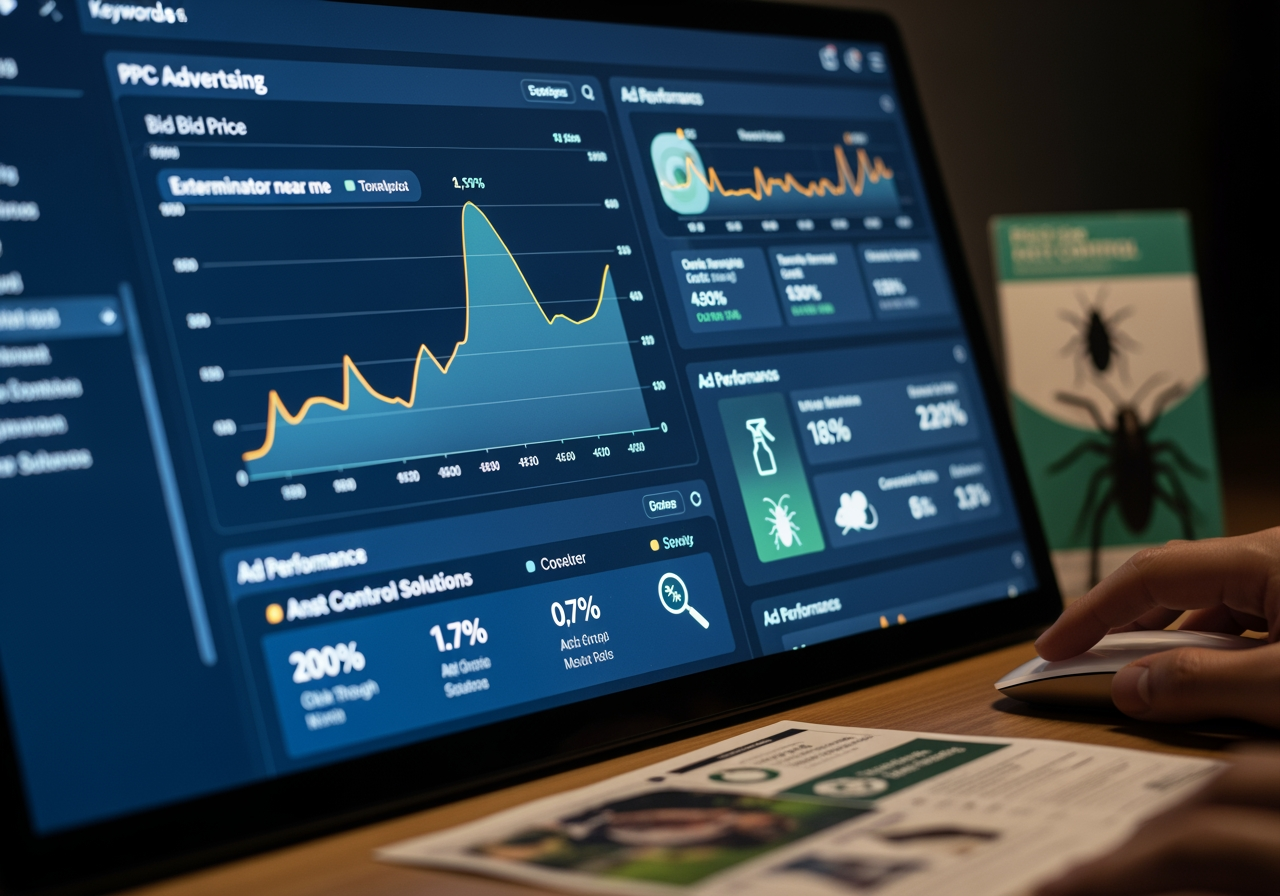
PPC is a powerful tool for lead generation because we only pay when someone clicks on our ad. This means we're paying for users who have shown direct intent by clicking, making it a highly cost-effective strategy when managed correctly. Studies show that 65% of all high-intent searches result in a paid ad click rather than an organic listing. For pest control, where urgency is key, emergency-related searches have conversion rates up to 3x higher than regular searches, making PPC an indispensable part of our marketing strategy.
Keyword Strategy for Service Businesses
The foundation of any successful PPC campaign is robust keyword research. For pest control, this means identifying the specific words and phrases potential customers use when searching for our services, especially when they're in a crisis.
- Emergency Keywords: These are high-intent, urgent terms like "emergency pest control [city]," "24-hour exterminator," or "wasp nest removal immediate." Over 7 out of 10 emergency pest control searches happen on mobile devices, and users typically call within 5-10 minutes of searching. These keywords often have higher Cost Per Click (CPC) but also higher conversion rates. The highest CPC keywords in pest control typically include 'Emergency pest control [city]' ($15-25 per click) and '24 hour exterminator' ($12-20 per click).
- Service-Specific Terms: Target keywords related to the specific pests we treat, such as "bed bug treatment [city]," "termite control services [city]," "rodent exterminator," or "mosquito control." These terms also indicate strong intent.
- Local Intent Modifiers: Always include geographic modifiers in our keywords, like city names, neighborhoods, or "near me." This ensures our ads reach customers in our service areas.
- Negative Keywords: Just as important as selecting the right keywords is identifying negative keywords. These are terms we don't want our ads to show for (e.g., "DIY pest control," "pest control jobs," "free pest control tips"). Ignoring negative keywords is a common mistake that can quickly drain budgets without generating meaningful leads.
- Competitor Research: Analyze what keywords our competitors are bidding on. Tools like SEMrush can provide insights into their strategies, helping us identify opportunities or gaps in our own keyword list.
Structuring Campaigns for Maximum Impact
An organized campaign structure is vital for efficient PPC management and optimal performance. We need to segment our campaigns and ad groups to ensure maximum relevance between keywords, ad copy, and landing pages.
- Campaign Structure by Service Type: Create separate campaigns for different pest types or service categories (e.g., "Termite Control," "Rodent Extermination," "General Pest Control," "Emergency Services"). This allows us to allocate budgets, target specific audiences, and tailor ad copy more effectively.
- Geo-targeting: Precisely target our ads to specific geographic areas. This can be done by city, zip code, or a radius around our business location. Since pest control is a local service, geo-targeting ensures our ads are seen by potential customers within our service areas, minimizing wasted spend.
- Ad Scheduling: Schedule our ads to run during hours when our team is available to answer calls or respond to inquiries. Peak conversion rates for pest control services are typically between 7 AM and 11 PM.
- Mobile-First Ads: Given that over 70% of pest control leads come from mobile devices, our ads and landing pages must be optimized for mobile users. This includes call-only ads that allow users to directly call us with a single tap.
Here's a quick comparison of PPC and SEO for local businesses:
Feature PPC (Paid Search) SEO (Organic Search) Visibility Immediate, top of search results (ads) Gradual, earned rankings (organic listings) Speed Fast results (within hours/days) Slower results (weeks/months) Cost Model Pay-per-click (CPC) or pay-per-lead (LSA) No direct cost per click, but requires investment in optimization Control High control over targeting, budget, messaging Less direct control, relies on algorithm updates Lead Quality High-intent, often urgent leads High-intent, often research-focused leads Scalability Highly scalable with increased budget Scalability tied to content and authority building Data & Insights Rich, immediate data on performance, costs, ROI Analytics provide insights, but often retrospective Designing High-Converting Landing Pages
A well-crafted PPC ad is only half the battle. Once a potential customer clicks, they need to land on a page that reinforces the ad's message and guides them towards conversion. High-converting landing pages are crucial for pest control PPC. Research suggests that having 10 to 15 dedicated landing pages can improve conversions by up to 55%.
- Matching Ad Message: The landing page content, headline, and offer must directly match the ad that brought the user there. This creates a seamless experience and reduces bounce rates.
- Clear Call-to-Action (CTA): A prominent and urgent CTA is essential (e.g., "Call Now for a Free Estimate," "Schedule Same-Day Service," "Get a Quote"). Make it easy for users to take the next step.
- Trust Signals: Include elements that build trust, such as customer testimonials, industry certifications, guarantees, and local awards. For pest control, showing licenses and insurance is vital.
- Mobile Responsiveness: With most emergency searches happening on mobile, landing pages must be fully responsive and load quickly on all devices. Tap-to-call buttons and easy-to-fill forms are critical.
- Fast Load Times: Slow-loading pages frustrate users and negatively impact Quality Score, which can increase our CPC. Optimize images and code to ensure rapid loading.
Advanced Strategies for Local Business Marketing
Beyond the foundational PPC and SEO tactics, several advanced strategies can significantly improve our lead generation and customer acquisition efforts for pest control businesses.
Leveraging Google Local Services Ads (LSAs)
Google Local Services Ads (LSAs) are a game-changer for home service businesses, including pest control. These ads appear at the very top of Google search results, even above traditional PPC ads, and feature businesses that are "Google Guaranteed."
- Google Guarantee: This badge signifies that Google stands behind our work, offering consumers peace of mind. It's a powerful trust signal that can significantly increase call volume.
- Pay-Per-Lead Model: Unlike traditional PPC, where we pay for clicks, with LSAs, we only pay for qualified leads. This means we're paying for actual phone calls or messages from customers looking for our services, making it a highly efficient spend.
- Trust Building: The Google Guaranteed badge, combined with customer reviews displayed directly in the ad, builds immediate credibility with potential clients.
- LSA vs. Traditional PPC: While traditional PPC offers more control over keywords and ad copy, LSAs provide unparalleled visibility and a pay-for-performance model that is particularly attractive for service businesses. Integrating both can create a comprehensive top-of-funnel presence. For a detailed comparison, explore our insights on GLSA vs Traditional PPC for Your Business.
Re-engaging Customers with Remarketing
Not every website visitor will convert on their first visit. Remarketing allows us to re-engage these potential customers by showing them targeted ads as they browse other websites or social media platforms.
- Targeting Past Website Visitors: We can create audience lists of people who visited our website but didn't convert (e.g., didn't fill out a form or call).
- Display Ads: Show visually compelling display ads across the Google Display Network, reminding them of our services and special offers.
- Custom Audiences: Leverage platforms like Facebook to create custom audiences based on website visitors, allowing for highly targeted social media remarketing campaigns.
- Nurturing Leads: Remarketing campaigns can be used to nurture leads by offering different messages or incentives (e.g., a discount for first-time customers, information about our eco-friendly options) to encourage them to return and convert.
Choosing a Partner for Your Local Business Marketing
Managing a successful pest control business is a full-time job. Tackling complex digital marketing strategies, especially PPC, can be overwhelming and time-consuming. Many businesses find success by partnering with an agency specializing in home service local business marketing.
- Specialized Agencies: A specialized pest control PPC agency understands that pest control is seasonal, certain pests peak in different regions, and customers often want immediate results. They know the ins and outs of the industry, including critical seasonal trends and local market dynamics.
- Industry Expertise: These agencies distinguish keywords that convert from those that drain budgets, focusing on highly specific, high-intent keywords. They understand the unique challenges pest control businesses face, like targeting specific geographic areas or adjusting campaigns based on weather conditions and pest outbreaks.
- Transparent Reporting: A reputable agency provides transparent reporting, offering insights into keyword performance, ad spend, conversion rates, and overall ROI. This ensures we always know where our money is going and the results it's generating.
- Case Studies: Look for agencies with a strong track record, including case studies, testimonials, and success stories demonstrating increased leads, lower Cost per Acquisition (CPA), and higher return on investment for pest control companies.
Measuring What Matters: Tracking Your Marketing ROI
Effective marketing isn't just about spending money; it's about generating a measurable return on that investment. For pest control PPC management, tracking our performance is non-negotiable. Accurate conversion data is crucial for determining costs per lead or per acquisition. Ongoing optimization is key, focusing on clicks that convert and blocking those that don't.
Essential KPIs for Local Service Businesses
Key Performance Indicators (KPIs) help us understand the effectiveness of our campaigns and make data-driven decisions.
- Cost Per Lead (CPL): This measures how much we spend to acquire one lead. Target CPL for Emergency Services is typically $45-75, for Regular Residential Services $100-150, and for Commercial Services $120-500. A common cost per lead in pest control can range from $20-$80 depending on region and pest type.
- Cost Per Acquisition (CPA): This is the cost to acquire a paying customer. It's a critical metric for understanding profitability.
- Conversion Rate: The percentage of ad clicks or website visitors that complete a desired action (e.g., call, form submission, booking). Industry benchmarks for pest control PPC conversion rates are: Emergency service calls: 15-25%, Free inspection requests: 10-20%, Service plan sign-ups: 8-15%.
- Return On Ad Spend (ROAS): This calculates the revenue generated for every dollar spent on advertising. It's a direct measure of our campaign's profitability.
Tools and Techniques for Accurate Tracking
To accurately measure these KPIs, we need robust tracking mechanisms in place.
- Call Tracking: Since many pest control leads come via phone, especially for emergency services, call tracking is essential. This allows us to attribute phone calls directly to specific ads, keywords, or campaigns.
- Form Submission Tracking: Implement conversion tracking for all contact forms on our website and landing pages. This can be done using Google Tag Manager and Google Analytics.
- UTM Parameters: Use UTM parameters in our ad URLs to track the source, medium, and campaign of website traffic, providing granular data in Google Analytics.
- Setting Up Goals: Configure goals in Google Analytics for key conversion events, such as phone calls, form submissions, and online bookings.
Frequently Asked Questions about Local Business Marketing
How long does it take to see results from local marketing efforts?
The timeline for seeing results can vary significantly depending on the strategy. PPC advertising can deliver near-immediate results, with many pest control companies seeing initial results within the first 24 hours for emergency service calls. For regular service inquiries, results often appear within the first week, and measurable ROI data typically emerges within the first month. Optimized campaign performance is usually achieved within 3 months.
In contrast, Local SEO and organic content strategies tend to yield results over a longer period, often taking several weeks to months to show significant improvements in rankings and organic traffic. An integrated approach, combining the speed of PPC with the long-term benefits of SEO, is often the most effective.
PPC vs. SEO: Which is better for a new service business?
Both PPC and SEO are crucial, but they serve different purposes and offer distinct advantages. For a new pest control business looking for immediate lead generation, PPC is often the faster route. It allows us to quickly gain visibility at the top of search results and start generating calls and form submissions almost instantly. This is particularly beneficial for capturing urgent, high-intent searches.
SEO, while vital for long-term sustainable growth and building brand authority, takes time to build momentum. A new business might struggle to rank organically for competitive terms quickly. Therefore, a common strategy is to start with a strong PPC campaign to generate initial leads and revenue, while simultaneously investing in SEO for long-term organic growth. Over time, as SEO efforts mature, the reliance on PPC can be adjusted.
How much should a local business budget for digital marketing?
The average pest control company spends $1,500-$5,000 monthly on PPC advertising. However, our specific budget should be custom to several factors:
- Service Area Size: Larger service areas or multiple locations will generally require a higher budget.
- Types of Pests Targeted: Highly competitive or high-value pest services (e.g., termites, bed bugs) may require higher bids.
- Seasonal Competition: Budgets should be adjusted seasonally, increasing during peak pest seasons (spring and summer) when demand is highest.
- Target Cost Per Acquisition (CPA): Based on our average job value and desired profit margins, we can determine a target CPA. For example, a target CPA for Emergency Services might be $45-75, while for Regular Residential Services, it could be $100-150.
- Overall Marketing Goals: Our budget should align with our growth objectives.
It's advisable to start with a manageable budget, closely track performance, and then scale up spending as campaigns prove profitable. Continuous optimization is key to ensuring every marketing dollar is spent efficiently.
Conclusion
Effective pest control PPC management is not merely an option but a necessity for driving growth in today's competitive digital landscape. By building a strong Local SEO foundation and accelerating our efforts with targeted PPC campaigns, we can ensure our business is visible to potential customers precisely when they need us most. Leveraging advanced strategies like Google Local Services Ads and remarketing further refines our reach, while meticulous tracking of KPIs ensures our marketing spend translates into tangible ROI.
The future of local marketing for pest control businesses lies in an integrated, data-driven approach that combines immediate lead generation with sustainable long-term growth. By understanding and implementing these strategies, we can eliminate the competition and grow our business, one successful campaign at a time. Ready to transform your lead generation?
Most read in News
Trending articles on News
Top articles on Minutehack


 Share article via email
Driving Growth: Effective Marketing Strategies For Local and Service-Based Businesses
Thanks for signing up to Minutehack alerts.
Brilliant editorials heading your way soon.
Okay, Thanks!