

Key Takeaways
- Business analytics is essential for transforming raw data into actionable insights and smarter decisions.
- AI-driven analytics are accelerating efficiency and enabling organizations to innovate rapidly.
- Building a culture of data-driven thinking is paramount to maximizing the value of analytics investments.
Table of Contents
- Understanding Business Analytics
- The Role of AI in Business Analytics
- Building a Data-Driven Culture
- Real-World Applications of Business Analytics
- Challenges in Implementing Business Analytics
- Future Trends in Business Analytics
- Conclusion
In an era where every decision counts, organizations across the globe are turning to business analytics to navigate the complexities of the digital landscape. Business analytics empowers companies to harness data and unlock critical insights, driving strategies that lead to measurable improvements in efficiency and growth. For professionals and students looking to lead in this evolving field, pursuing a MIS degree online can provide a robust foundation in analytics, data management, and decision support systems.
Data-driven approaches are no longer optional but critical for staying ahead of the competition. Companies that successfully adopt analytics enjoy advantages in efficiency, customer experience, and innovation. Investing in the right skills and tools can have a transformative effect on every area of an organization, from strategic planning to day-to-day operations.
Understanding Business Analytics
Business analytics is the practice of using statistical techniques, technologies, and processes to examine historical and current data, uncovering trends, and gaining actionable insights. These insights help organizations to fine-tune their operations, recognize opportunities, and mitigate risks. By leveraging business analytics, decision-makers can answer critical questions such as why specific results occurred, what might happen in the future, and which strategies are most likely to yield success.
Analytics goes beyond reporting historical data. Unlike traditional reporting, analytics applies sophisticated statistical models and predictive algorithms, enabling organizations to anticipate industry shifts and respond proactively. Research from the Harvard Business Review underscores the value of regression analysis and other data science techniques in shaping more insightful, responsive organizational strategies.
The Role of AI in Business Analytics
Artificial intelligence has rapidly emerged as a game-changer in business analytics. AI technologies automate routine data analysis tasks and boost productivity by processing immense volumes of data in real time. With machine learning algorithms, organizations can spot patterns that would elude even the most skilled analysts, identify correlations, and predict outcomes with remarkable accuracy.
More advanced uses of AI include natural language processing to analyze customer sentiment and computer vision to interpret visual data, both of which are being deployed in a wide array of sectors. By infusing analytics platforms with AI, organizations can convert raw data into forward-looking insights that guide strategic decision-making and operational improvements.
Building a Data-Driven Culture
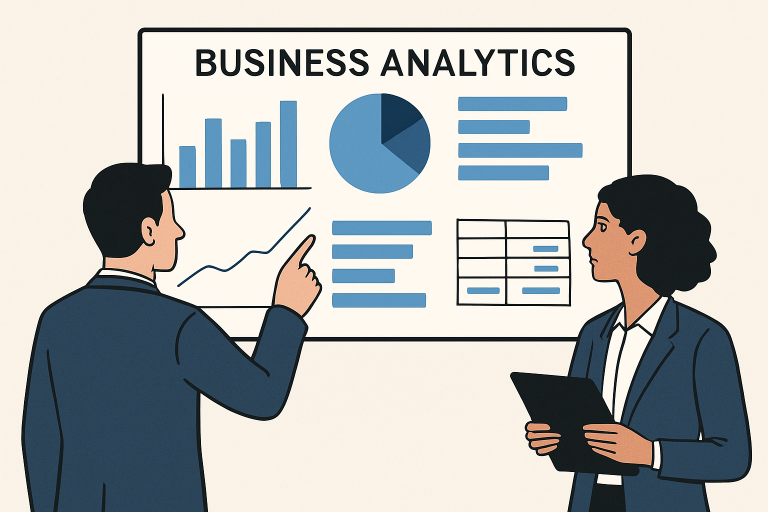
Even the most sophisticated analytic tools cannot have their full impact unless an organization fosters a data-driven culture. This requires more than just technology adoption; it demands a collective mindset shift where individuals at every level value evidence-based decisions over intuition or tradition. Leaders must prioritize transparency, encourage collaboration around data, and provide training to equip employees with the analytical skills they need.
Implementing easy-to-use data visualization tools and dashboards enables employees to interact with data daily, fostering accountability and curiosity. Organizations such as Forbes highlight how embracing data-driven cultures improves organizational agility and decision quality.
Real-World Applications of Business Analytics
The impact of business analytics is evident across numerous sectors:
- Retail: Predictive analytics helps optimize inventory levels, design effective loyalty programs, and tailor marketing messages to individual consumer preferences.
- Healthcare: Providers employ analytics to predict patient admissions, personalize treatment plans, and efficiently allocate staff and resources.
- Financial Services: Analytics enables real-time fraud detection, portfolio optimization, and risk assessment, offering institutions a competitive advantage.
- Manufacturing: Companies use predictive maintenance analytics to identify potential equipment failures before they cause costly downtime.
These diverse applications illustrate how analytics solutions can improve operational efficiency and overall outcomes across industries.
Challenges in Implementing Business Analytics
Despite its clear benefits, implementing business analytics successfully can be challenging. Common obstacles include data quality issues, siloed systems that hinder integration, resistance to organizational change, and a shortage of qualified analytics professionals. Addressing these barriers requires strong leadership, investment in continuous training, and a commitment to building robust data infrastructures. According to McKinsey & Company, organizations that confront these challenges proactively are more likely to realize tangible returns from their analytics efforts.
Future Trends in Business Analytics
The future of business analytics is exciting, driven by AI, machine learning, and big data. AI agents are helping with data integration, while real-time analytics enhance decision-making. IoT and data lakes create richer data environments. As technology advances, user-friendly tools enable employees at all levels to access insights, with more self-service analytics and automated machine learning promoting innovation.
Conclusion
Business analytics stands at the forefront of the modern business revolution, enabling smarter, faster decisions and driving sustainable organizational growth. By adopting data-driven practices, integrating advanced technologies like AI, and nurturing a culture of curiosity and continuous learning, organizations are better positioned to thrive in a competitive, rapidly changing world. The time to invest in analytics skills, infrastructure, and culture is now, laying the foundation for ongoing success and innovation in the digital age.
Most read in News
Trending articles on News
Top articles on Minutehack


 Share article via email
How Business Analytics Is Redefining Organizational Success
Thanks for signing up to Minutehack alerts.
Brilliant editorials heading your way soon.
Okay, Thanks!